Colorado Homerule and Avalara Setup
The first question I get often is when do you need to register in a City or a HomeRule. Note none of the below is legal or financial advice, please speak to a SALT attorney such as TaxOps if you have questions specific to your business.
A company should register with a Colorado home rule city (such as Denver) as soon as it has nexus with that city, which generally arises from:
Physical presence in the city, or
Exceeding the city’s economic nexus threshold (commonly $100,000 in annual sales delivered into the city)
Sometimes things like Amazon or where Amazon stores your goods can also trigger nexus in a state.
What to do in Avalara?
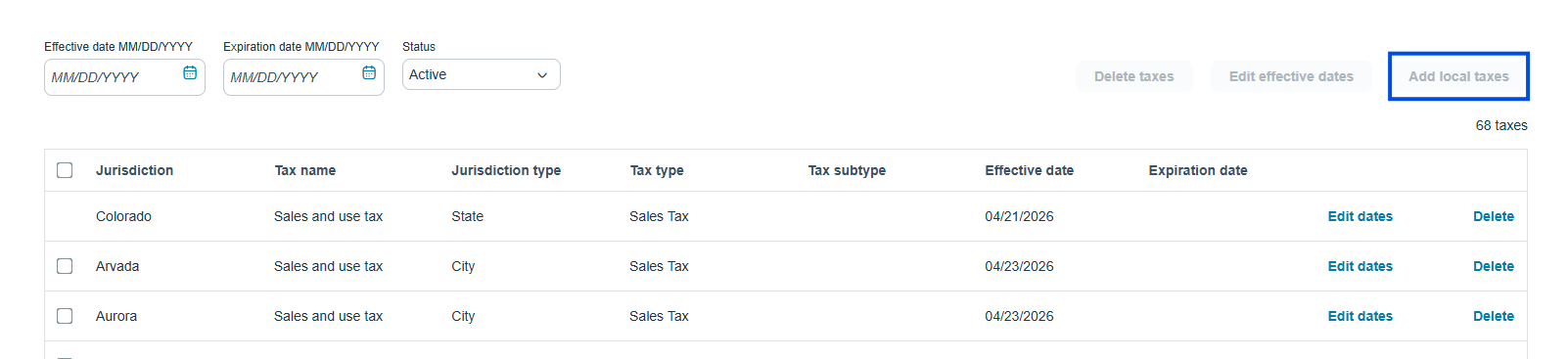
Inside of Avalara, in the Settings » Where you collect tax » United States » Colorado you have the option to add local taxes. If you do not add them, Avalara will NOT collect tax there. I.e. Cities like Denver work like a State, if you don’t tell Avalara you’re registered there, you should NOT be collecting tax there. You wouldn’t collect sales tax in OH if you’re not registered there, same applies here. There’s around 67 local taxes in CO. This information must be provided to the company setting up your Avalara, otherwise, no city would be automatically assumed.
If you are participating in SUTS that also should be indicated to properly setup what cities you’re participating with. SUTS Participating Jurisdictions | Department of Revenue - Taxation
Configuring your returns with Avalara
DR 0100 Sales Tax
DR 0173 Retailer's Use Tax
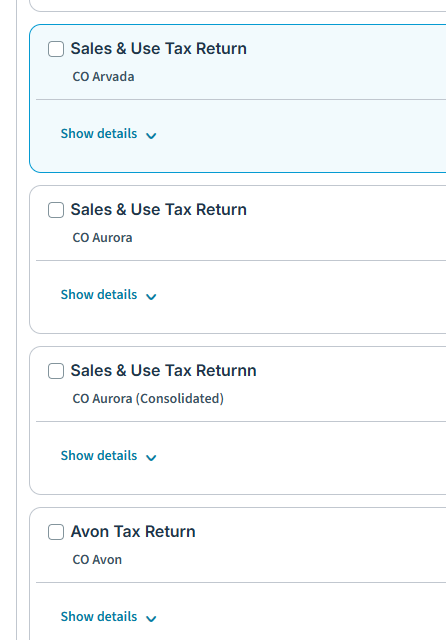
Home-rule city filings
They are not interchangeable.
Rule of thumb when setting up Avalara Returns
Add DR 0100 when:
The taxpayer has a Colorado sales tax license and files sales tax with the state.
This is the obligation most Colorado businesses have. It covers:
State sales tax
State-collected local taxes
SUTS-participating jurisdictions that are remitted through the Colorado filing process.
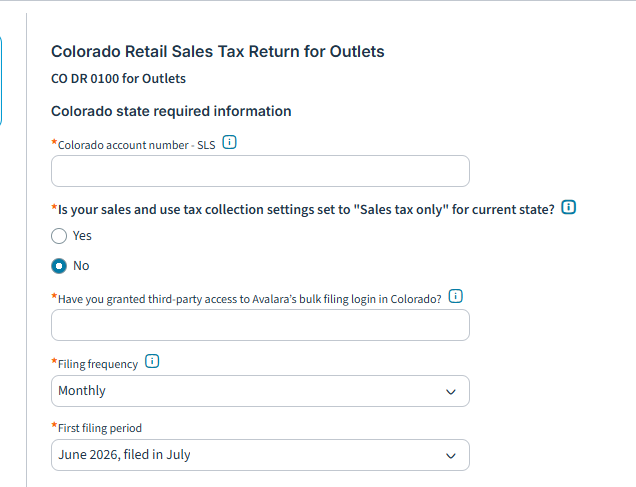
Note: In your Settings » Where you collect tax ensure Tax Type = Sales Tax (this is normally used as the default if not specified)
Add DR 0173 when:
The taxpayer has an actual Retailer's Use Tax account and is required to collect retailer's use tax on delivered sales.
The DR 0173 is specifically the Retailer's Use Tax Return and is used to report Colorado retailer's use tax and certain special district use taxes. It is not simply "another Colorado sales tax return."
When reviewing prior filings, if you never see a DR 0173 being filed and only see DR 0100 filings, I would not automatically create a DR 0173 obligation.
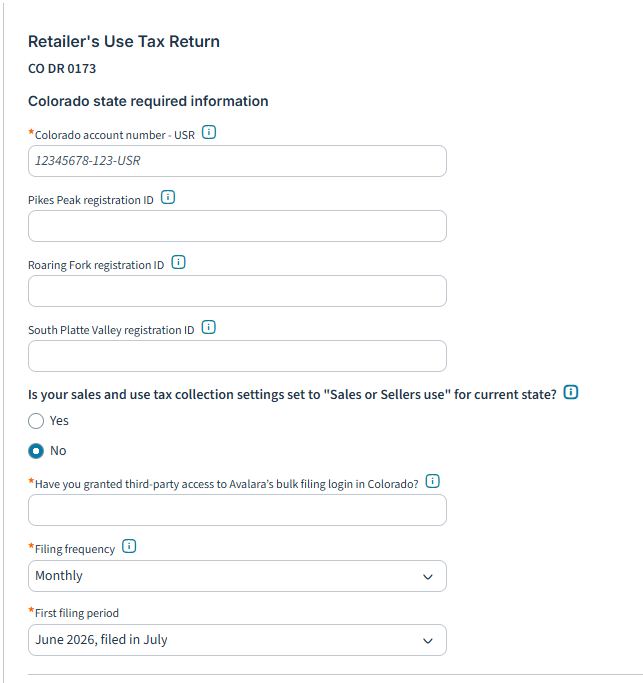
Note: In your Settings » Where you collect tax ensure Tax Type = Sellers Use Tax (this is actually uncommon and would not be the default setup)
The city question
Do NOT add cities individually when:
The city is:
State-collected, or
A home-rule city that participates in SUTS and the client files through SUTS
SUTS allows filing for state-collected jurisdictions and participating home-rule jurisdictions through a single portal.
Examples of home-rule cities participating in SUTS include:
Longmont
Lafayette
Fort Collins
Lakewood
and many others.
In those situations, adding separate city returns in Avalara can create duplicate filing obligations.
Add cities individually when:
The city is a non-participating home-rule city.
Colorado specifically states that if a home-rule jurisdiction does not participate in SUTS, the taxpayer must remit directly to that jurisdiction.
Those are the jurisdictions that often end up as separate Avalara Returns registrations.
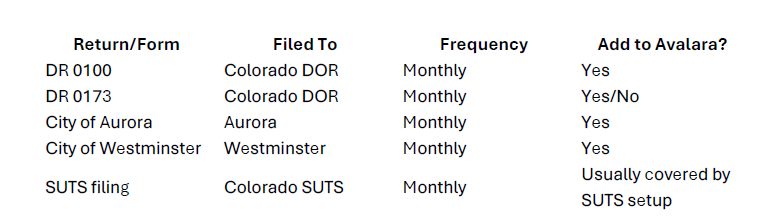
Look for the form number DR 0100
If the return says DR 0100 Retail Sales Tax Return, that's a Colorado sales tax obligation.
Things you'll typically see:
State sales tax reported
County/city/special district schedules
Gross sales and taxable sales
Jurisdiction breakdowns
Conclusion: Add a Colorado Sales Tax filing obligation.
DR 0173
If the return says DR 0173 Retailer's Use Tax Return, that's a separate retailer's use tax filing obligation.
Conclusion: Only add this if they're actually filing it.
Look for where the return was filed
SUTS Filing
If the return package references:
Colorado SUTS
Sales & Use Tax System (SUTS)
Home-rule jurisdictions listed together in a SUTS filing
Then many of those local taxes may already be covered through the SUTS process.
Direct City Filings
If you find separate returns with names like:
City of Aurora
City of Colorado Springs
City of Westminster
City of Thornton
and they are filed directly to the city rather than through Colorado DOR/SUTS, then those are likely separate Avalara obligations.
In CO DOR you can normally obtain things like Location IDs (if your DOR is configured correctly)
Down under the Sales Tax account, click “View, Add, or Close Sales Tax Locations”
Click “View Business Location Rates”
Click “Export”